
Gazebo Installation
How to Choose the Right Gazebo Size for Your Backyard
By Premier Assembly · 2026-09-29
A practical guide to comparing gazebo sizes — footprint vs. usable space, measuring your backyard, decks and patios, access, and manufacturer dimensions — so you buy the right size before installation.
Quick Answer
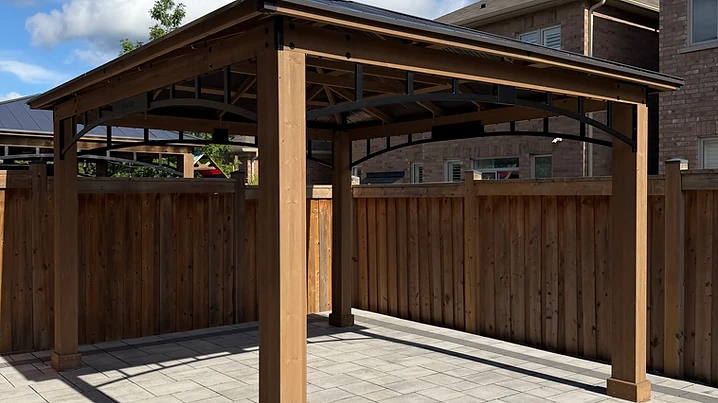
Choosing a gazebo size is rarely just about whether the structure "fits." The listed dimensions describe the gazebo's footprint, but the space you actually need depends on how you'll use the area around it — furniture, walking paths, doors, stairs, deck edges, and the room required to assemble the kit. This guide covers how to compare common gazebo sizes, measure your space, and avoid the mistakes that turn a "perfect fit" into a difficult installation.
Footprint vs. Usable Space
A gazebo's advertised dimensions (for example 10×12 or 12×14) describe its outer footprint — the area the structure covers once assembled. That number does not tell you:
- how much room you need to walk around it
- whether your furniture fits comfortably underneath
- how close the posts sit to doors, stairs, railings, or deck edges
- how much clearance the manufacturer requires from fences, walls, or other structures
- the access needed to deliver and stage the package and to assemble it
Actual clearance and spacing requirements depend on the specific product, your site, and the manufacturer's installation instructions. Check the product documentation rather than assuming a universal minimum.
Common Gazebo Sizes
The sizes below are general planning categories. They are not promises about what furniture will fit or how many people a gazebo will hold — usable space depends on the product's post layout, roof design, and your furniture.
| Size | General use | What to think about |
|---|---|---|
| 8×8 | Compact footprint for smaller spaces or simpler setups. | Limited interior room; confirm your furniture and movement fit. |
| 10×10 | A common compact-to-medium option. | Works for modest seating; check post placement relative to edges. |
| 10×12 | Useful when you want more rectangular usable space. | Extra length helps with seating or a small dining setup. |
| 12×12 | More room for furniture and entertaining. | Larger footprint needs more available area; check clearance on all sides. |
| 12×14 | A larger footprint that accommodates more uses. | Verify access and that the rectangle aligns with your surface. |
| Larger (12×16, 12×20, 12×24) | For properties with enough space and a specific need. | Confirm delivery access, assembly room, and surface support. |
Premier Assembly has not personally installed every size listed above. These are general homeowner planning categories. Where we reference a specific installation, it comes from our actual project portfolio.
Match the Size to How You'll Use It
The right size depends on how you actually use the space. A gazebo for quiet morning coffee needs less room than one meant for a dining table, a grill setup, or entertaining. Before deciding, picture a typical use: how many people, what furniture, and whether you'll move around freely underneath. That picture — more than the number on the box — tells you whether a compact or larger footprint makes sense.
How to Measure Your Space
- Measure the available area. Tape out the full rectangle you have to work with, not just where the gazebo will sit.
- Mark the proposed footprint. Use stakes, paint, or tape to outline the gazebo's actual dimensions at the manufacturer's listed size.
- Account for doors and access. Confirm doors, gates, and entryways still open and you can reach the gazebo comfortably.
- Identify obstacles. Note railings, stairs, downspouts, AC units, gas lines, fences, and landscaping near the footprint.
- Consider the surrounding walking area. Leave practical room to walk around the gazebo and maintain the structure.
- Check the manufacturer's actual dimensions. Use the product documentation, not only the retailer listing title — two products called "10×12" can differ.
- Confirm the installation surface. Know whether you're on concrete, interlock, a wood deck, composite, or ground, since anchoring differs.
- Consider assembly access. The crew needs room around the structure to work safely during installation.
If your property is near a lot line, or your municipality has setback or permit requirements, verify what applies with your local municipality. We don't provide property-line or permit advice as universal fact.
Choosing a Gazebo Size for a Deck
A deck is one of the most common — and most often miscalculated — gazebo locations. Before choosing a size, consider:
- the actual deck dimensions, not just the visible surface
- usable deck area after railings, stairs, and post locations
- how close the gazebo posts land to the deck edge
- doors and how they swing relative to the structure
- existing furniture and traffic flow
- the deck surface material and whether it can support the anchoring method
We don't recommend a specific gazebo size for a specific deck size — the right answer depends on the product and your deck. For more, see our guide to gazebo installation on a wood or composite deck.
Patio, Interlock, and Concrete
The same principle applies to concrete patios, interlock, and pavers: think about the usable area and installation requirements, not just whether the footprint appears to fit. Posts, anchoring, and the surrounding walking area all matter.
See also: gazebo installation on concrete and gazebo installation on interlock or pavers.
Package, Delivery, and Access
A gazebo can fit in its final location while the packaged components and assembly process still need reasonable access. Before you buy, think about:
- gate widths and narrow side yards
- stairs or corners the delivery has to clear
- fences, landscaping, and overhead branches
- where the boxes can be staged near the install area
This isn't a universal delivery rule — it's a reminder to check access before purchasing so installation day goes smoothly.
Check the Manufacturer's Actual Dimensions
Two gazebos advertised as the same general size can differ in:
- post layout and corner placement
- roof overhang and overall height
- usable interior dimensions
- anchoring requirements
- assembly sequence
Always confirm with the manufacturer's product documentation. If you're considering a specific brand, our brand pages cover what we've seen in the field — for example Yardistry, Sojag, Hampton Bay, Purple Leaf, and Sunjoy. We're not affiliated with any manufacturer.
Before You Buy Checklist
- Measure the available area
- Confirm the product's actual dimensions
- Check the installation surface
- Think about furniture and intended use
- Check doors, stairs, and walkways
- Check access to the installation area
- Identify obstacles near the footprint
- Review manufacturer installation requirements
- Consider anchoring requirements
- Check applicable local requirements
- Keep the product/model information for the installer
Common Gazebo Size Mistakes
- Measuring only the gazebo footprint and ignoring the space around it
- Forgetting to plan for furniture and movement
- Ignoring doors, stairs, and how they swing
- Overlooking deck edges and railing clearance
- Buying based only on a retailer title instead of the actual model dimensions
- Assuming every gazebo has the same post and roof layout
- Not considering how the gazebo will be used day to day
- Overlooking delivery and assembly access
Real Gazebo Installations
Premier Assembly has completed 1,000+ outdoor structure installations. Our portfolio includes real gazebo projects across different brands, sizes, cities, and surfaces. A few examples:
- Canvas Coastline 10×10 gazebo in Markham
- Yardistry Meridian 10×12 gazebo in Mississauga
- Hampton Bay Winfield 10×12 gazebo in Brampton
- Yardistry 12×14 gazebo in Whitby
- Yardistry Meridian 12×16 gazebo in Hamilton
These are real projects from our records. We don't claim the portfolio represents every size or manufacturer. See more in our work and on our gazebo installation service page.
Not Sure What Size You Need?
If you're between two sizes, compare the manufacturer's actual dimensions with the space available and think about how you plan to use the gazebo. If you'd like help, send us the product details, the size, and photos of the installation area — we can review the project information when preparing an installation quote. We don't provide architectural, engineering, or design services.
For more, see what to check before buying a gazebo, what to do after buying a gazebo, gazebo anchoring basics, and what information we need for a quote.
Send us the product details, size, location, and photos of the installation area and we'll review the project for a quote.
Related service
View serviceFAQ
- What size gazebo should I get for my backyard?
- Start with how you'll use it and the space you actually have. Compare the manufacturer's real dimensions to your measured area, leaving room for furniture, walking, and access. There's no single right size — it depends on your yard and intended use.
- Is a 10×10 gazebo big enough?
- For many homeowners a 10×10 works for modest seating in a smaller yard. Whether it's enough depends on your furniture, how you move around it, and the product's interior dimensions. Check the manufacturer's specs before deciding.
- Is a 10×12 gazebo better than a 10×10?
- Not necessarily better — just different. A 10×12 gives more rectangular usable space, which can help with seating or a small dining setup, but it needs more available area. Choose based on your space and use, not the larger number alone.
- How much space do I need around a gazebo?
- It depends on the product, your site, and the manufacturer's instructions. Plan for walking room, furniture, doors, stairs, and maintenance access, and confirm any clearance the manufacturer specifies.
- Can I put a gazebo on a deck?
- Yes, many gazebos go on decks. Consider the deck dimensions, post placement near edges, railings, doors, and whether the deck surface supports the anchoring method. See our guide to gazebo installation on a deck.
- Should I measure my backyard before buying a gazebo?
- Yes. Measuring first — and marking the proposed footprint — helps you avoid buying a size that doesn't fit your space or access. Use the manufacturer's actual dimensions, not just the retailer title.
- Do different gazebo models have different actual dimensions?
- Yes. Two gazebos advertised as the same size can differ in post layout, roof dimensions, interior space, and anchoring requirements. Always check the manufacturer's product documentation for the model you're considering.